

Main Menu  

5 Meaningful Ways to Honor Veterans in Church

As followers of Christ, we are called to give “honor to whom honor is due” (Romans 13:7). Veterans have given of themselves in service to our nation—many at great personal cost. The church has a wonderful opportunity to recognize their sacrifice and to remind them that their service reflects the heart of Christ, who said, “Greater love has no one than this, than to lay down one’s life for his friends” (John 15:13).
Here are five meaningful ways your church can honor veterans this year.


1. Recognize Veterans Publicly During Worship

Take a few moments during your worship service to recognize all veterans in attendance. Invite them to stand and be acknowledged as the congregation expresses appreciation through applause or a special prayer of blessing. Consider playing a short video tribute or displaying photos of members who served. This visible act of honor reminds everyone of the value of sacrificial service.


2. Pray for Veterans and Their Families

A heartfelt prayer can be one of the most powerful ways to honor veterans. Pray for their physical and emotional healing, for peace in their hearts, and for their families who often bear unseen burdens. Include prayers for those currently serving and for those who carry scars—both visible and invisible—from their service. Prayer not only honors veterans but also invites God’s comfort and restoration into their lives.

Read More >>

10 Comical Reasons People Fall Asleep During Sermons

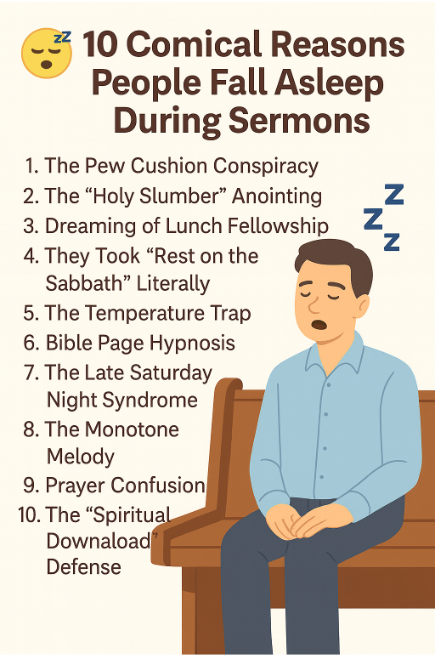
10 Comical Reasons People Fall Asleep During SermonsA Little Humor for the Hard-Working Pastor (with a sense of humor)

Every pastor knows the feeling — you’re delivering a heartfelt sermon, pouring out truth with passion, and there it is… someone in the third pew starts doing the slow nod. Their eyes close, their head tilts, and you just know they’re about to drift into what can only be described as “holy slumber.”

Before you take it personally, take comfort: even the Apostle Paul had one listener fall asleep — and that poor guy tumbled out of a window! (Acts 20:9). So, if it happened to Paul, it can happen to us.

To brighten your day and remind you that you’re not alone in this pulpit phenomenon, here are ten lighthearted reasons people might fall asleep during a sermon.

1. The Pew Cushion Conspiracy

Those pew cushions are far softer than they look. It’s like someone swapped them for memory foam the night before your message.

2. The “Holy Slumber” Anointing

They’re not asleep — they’re resting in the Spirit… with a gentle snore of agreement to your last point.

Read More >>

Why Pastor Appreciation Day Matters

Why Pastor Appreciation Day Matters

Every October, churches across the nation take time to honor their pastors and ministry leaders. While it’s easy to think of Pastor Appreciation Day as just another date on the calendar, it’s much more than that. It’s a heartfelt opportunity to say thank you to those who give their lives to serving God’s people.

A Biblical Foundation

The idea of showing appreciation to our pastors isn’t a modern invention—it’s rooted in Scripture. The Apostle Paul wrote, “Let the elders who rule well be considered worthy of double honor, especially those who labor in preaching and teaching” (1 Timothy 5:17). Likewise, 1 Thessalonians 5:12-13 reminds us to “respect those who labor among you and are over you in the Lord.”
Pastor Appreciation Day provides a special moment to put those verses into action.

Recognizing Faithful Service

Pastors carry spiritual, emotional, and sometimes physical burdens that most never see. They counsel hurting hearts, pray for struggling families, comfort the grieving, and stand ready in times of crisis—all while faithfully preaching and teaching God’s Word. Taking a Sunday to recognize that kind of devotion says, “We see your heart, and we thank you.”

Read More >>

Top 4 Questions People Have about Christianity

I did some research on the “Top 4 Questions People Have about Christianity” and wanted to share the findings.

While every non-Christian comes with their own background and curiosity, surveys and conversations often reveal four recurring questions people want answered about Christianity:

1.  “Who is Jesus, really”?

Answer:
Jesus is more than just a wise teacher or prophet. 

He claimed to be God in the flesh who came to rescue us.  In John 14:6, Jesus said, “I am the way, the truth, and the life. No one comes to the Father except through Me.” His resurrection from the dead is the greatest evidence of His identity (1 Corinthians 15:3-4). No other religious leader predicted and accomplished their resurrection.

👉 In conversation: “Jesus didn’t leave us the option to see Him only as a good man. He either was who He claimed to be—the Son of God—or not at all. His empty tomb is history’s loudest testimony.”

2.  “Why do I need Salvation?” 

Answer:
The Bible teaches that all have sinned (Romans 3:23) and fall short of God’s perfect standard. Sin isn’t just doing bad things; it’s our broken relationship with God. Even our best efforts can’t erase guilt or earn heaven (Isaiah 64:6). That’s why God sent His Son. Romans 6:23 says, “The wages of sin is death, but the gift of God is eternal life in Christ Jesus our Lord.”

👉 In conversation: “It’s not about being better than others. It’s about being made right with God, and that only comes through Jesus.”

Read More >>

The Beautiful Feet of the Gospel

The Beautiful Feet of the Gospel

How beautiful are the feet of those who bring good news.Romans 10:14–15

“How, then, can they call on the one they have not believed in? And how can they believe in the one of whom they have not heard? And how can they hear without someone preaching to them? And how can anyone preach unless they are sent? As it is written: ‘How beautiful are the feet of those who bring good news!’” – Romans 10:14–15 (NIV)


The Chain of the Gospel

In these verses, the Apostle Paul lays out a simple yet profound sequence of how the gospel advances. People cannot believe in Christ without hearing of Him. They cannot hear without someone proclaiming the message. And no one proclaims unless they are sent. Every conversion, every transformed life, begins with this divine chain: sending, preaching, hearing, believing, and calling upon the Lord.

This highlights a central truth: the gospel, though powerful, does not travel on its own. God has chosen to spread His saving message through the lips of His people. The call to preach and proclaim is not limited to pulpits—it belongs to every Christian who bears witness to Christ in word and deed.

Read More >>

>